Blog

  • The Role of Personal Journals in Modern Songwriting and Self-Expression

    The Role of Personal Journals in Modern Songwriting and Self-Expression

    I have noticed that my writing ideas rarely arrive as complete lyrics. They usually begin as a thought I want to remember, a strange phrase, a memory that keeps returning, or a feeling I cannot explain yet. Writing those fragments down gives them somewhere to live. Instead of forcing an idea into a song immediately, I can capture it while it still feels natural and return to it later.

    I have also found that private writing changes the pressure around songwriting. A journal does not need a chorus, rhyme, or clever ending. It can be messy. That freedom makes it easier to be honest, and honesty can reveal details that might disappear if every sentence were written for an audience. For modern songwriters, that private space can become a valuable source of lyrical material and self-expression.

    Why Personal Journals Matter to Songwriters

    A journal gives songwriters somewhere to collect the raw material of everyday life. That material might be an argument, a childhood memory, a conversation overheard at a coffee shop, or one sentence that suddenly feels meaningful.

    Journaling creates a record of experiences before memory smooths them over. Specific details can later become imagery, titles, verses, or hooks. A small gesture or phrase may eventually carry more emotional weight than the original event.

    Scholarship has described songwriting as an autobiographical activity and as a process of interpreting the self through lyrical craft. It can transform experience into something shaped for music.

    Turning Private Thoughts Into Lyrics

    Turning Private Thoughts Into Lyrics

    A journal entry and a finished lyric serve different purposes. A diary can wander, repeat itself, contradict itself, and explain everything. A song leaves room for melody, rhythm, repetition, and imagination.

    The songwriter’s job is noticing. Look for the sentence that still has energy, an unusually specific image, or a phrase that sounds natural. Then ask what the line could mean beyond the original situation.

    A breakup entry might contain dozens of explanations. The useful lyric may be an empty passenger seat, an unopened text, or a familiar street that suddenly feels different. Specificity gives emotion a physical shape.

    Letting Rough Material Stay Rough

    Early writing does not need to sound impressive. Polishing every thought immediately can remove the strange wording that makes it personal. A journal allows fragments to remain unfinished until the songwriter understands what they are trying to say.

    That freedom creates room for experimentation. Awkward phrases, contradictions, unfinished sentences, and strange observations can remain until their value becomes clear.

    This is where how modern songwriters use silence and space in lyrics fits. Journal writing does not always have to explain an emotion. Leaving a thought incomplete can preserve ambiguity, which can later become a deliberate lyrical choice.

    Journaling as a Form of Self-Expression

    Personal journaling can help songwriters understand what they are actually trying to express. Writing privately separates the experience of feeling something from the pressure to explain it to other people.

    A songwriter may begin with anger and discover disappointment underneath it. A page about loneliness might reveal a desire for recognition rather than simply company.

    Research on songwriting has found that participants can experience music-making as a way to express feelings, tell personal stories, and feel understood. A pilot study involving young people found strong qualitative themes around self-expression and accomplishment, although its quantitative measures did not show statistically significant changes in self-esteem or self-efficacy.

    Journaling does not automatically produce better songs. It gives writers space to investigate experiences before deciding what belongs in public music.

    Personal Does Not Mean Completely Literal

    Personal Does Not Mean Completely Literal

    Authentic songwriting does not require revealing everything. A songwriter can protect privacy while keeping the emotional truth of an experience.

    Names can change. Several memories can be combined. A real event can move to another setting. A private feeling can become a fictional character’s feeling. These changes do not necessarily make a song less honest. They can help the writer find a clearer emotional center.

    Autobiographical songwriting can involve both experience and imagination, with artistic choices shaping how personal material becomes public expression.

    Building a Useful Journaling Habit

    A songwriting journal should make capturing ideas easy.

    One space can hold unrestricted thoughts, while another stores promising lyrics, titles, images, rhymes, or melodic ideas.

    • Record details while they are fresh.
    • Revisit older entries for recurring images or emotions.
    • Save unusual language even when it seems irrelevant.
    • Mark lines that could become hooks, titles, or opening verses.

    Journaling can reveal recurring subjects and a natural lyrical voice.

    Authenticity Comes From Selection

    The strongest result is not a song that sounds like a diary entry. It carries the specificity of lived experience while using songwriting craft to make that experience communicable.

    That is why imperfect lyrics can make a song feel more authentic fits naturally into this process. A slightly awkward phrase or conversational expression can preserve the sense of a real person behind the lyric. Craft still matters, but perfection is not emotional credibility.

    FAQs: The Role of Personal Journals in Modern Songwriting and Self-Expression

    1. How can a journal help with songwriting?

    It provides a private place to collect memories, observations, phrases, and unfinished ideas that can become lyrics.

    2. Should songwriters turn journal entries directly into lyrics?

    Usually, no. Journal entries are raw material that can be selected, reshaped, and compressed into songs.

    3. Can journaling improve lyrical authenticity?

    It can preserve specific details and natural language from real experiences.

    4. Does a songwriting journal have to be private?

    It can be. Private early writing may reduce pressure before ideas are developed or shared.

    The Pages That Become Songs

    Personal journals capture experiences before they become polished stories. They hold contradictions, awkward phrases, tiny observations, and emotions that may seem insignificant. For a songwriter, that mess can be valuable. The journal collects life without immediately turning it into content, giving ideas time to develop.

    A song may begin as one sentence in a notebook. What happens afterward is the songwriter’s art.
  • Hello world!

    Welcome to WordPress. This is your first post. Edit or delete it, then start writing!

  • How Do Indie Bands Get Discovered? The Modern Path From Unknown to Heard

    How Do Indie Bands Get Discovered? The Modern Path From Unknown to Heard

    A band no longer needs a record-label executive sitting in the back of a club to get its first real break. A 20-second rehearsal clip, a packed basement show, a listener saving a song, or the right playlist placement can start the same chain reaction.

    That is the clearest answer to how do indie bands get discovered now: discovery happens across several connected places rather than through one gatekeeper. Social platforms create the first spark, streaming services measure listener response, live shows create loyalty, and human recommendations keep the momentum moving.

    For independent bands, that shift is both encouraging and demanding. Getting music distributed is easier than it once was. Getting people to care remains difficult.

    Discovery Has Become a Chain Reaction

    Think of modern music discovery as a sequence:

    Exposure → curiosity → listening → engagement → recommendation → fandom

    A person might see a band performing a chorus on Instagram, search for the full track on Spotify, save it, send it to a friend, and eventually buy a ticket. No individual step looks dramatic, but together they create measurable momentum.

    Berklee College of Music describes modern independent-artist marketing in similar terms: musicians need a recognizable identity, consistent releases, social activity, streaming visibility, and direct relationships with listeners rather than relying on a single promotional event.

    That matters because musicians sometimes chase the wrong milestone. A video reaching 100,000 passive viewers can be less useful than reaching 5,000 people who repeatedly listen, save the song, join an email list, or attend shows.

    Short-Form Video Has Become a Discovery Engine

    TikTok, Instagram Reels, and YouTube Shorts have dramatically shortened the distance between an unknown band and a potential audience. It is one way how independent artists make money.

    Bands do not necessarily need elaborate music videos. Rehearsal footage, songwriting sessions, unusual guitar parts, crowd reactions, acoustic versions, tour mishaps, and stories behind songs can all provide entry points.

    Berklee has documented how TikTok has affected music discovery and even how musicians think about song hooks and presentation. The platform can expose tracks to listeners before traditional radio or press becomes involved.

    The size of the potential audience explains why the format matters. Pew Research Center’s 2025 research found that roughly nine in ten U.S. teens use YouTube, while around six in ten use TikTok and Instagram. Those figures describe teenagers rather than the entire listening population, but they illustrate why visual platforms matter for bands targeting younger audiences.

    The Best Clip Is Not Always the Most Polished One

    The Best Clip Is Not Always the Most Polished One

    Bands frequently assume discovery requires cinematic production. Often, recognizability matters more. A useful short video gives someone a reason to stop scrolling within seconds. That could be an unusual vocal moment, a memorable lyric, a drummer doing something visually striking, or a room suddenly singing the chorus.

    The goal is not simply “going viral.” It is giving the right listener enough information to think, I want to hear the whole song.

    Streaming Platforms Turn Curiosity Into Evidence

    Social media can introduce the music, that support independent musicians but streaming behavior reveals whether interest survives beyond the clip.

    Spotify, Apple Music, YouTube Music, Bandcamp, and similar platforms allow listeners to move from casual discovery into deeper exploration. Saves, follows, repeat listening, playlist additions, and visits to other tracks can all indicate stronger interest than a single view.

    Berklee recommends that independent artists maintain complete profiles across major digital services and approach playlisting strategically. It also notes that playlist discovery includes editorial, algorithmic, and listener-created playlists—not only the enormous branded playlists musicians tend to chase.

    One important warning: legitimate discovery should not be confused with purchased streams or guaranteed playlist placements. Artificial activity may increase a number on a dashboard without producing listeners who remember the band.

    Releasing More Strategically Creates More Chances to Be Found

    An album creates one major promotional moment. A sequence of singles creates several. Berklee’s 2025 guidance suggests that, for many independent artists, releases approximately six to eight weeks apart can keep listeners engaged while giving individual songs enough time to develop. That should not be treated as an iron rule; recording budgets, genre expectations, touring schedules, and songwriting pace vary enormously.

    The broader principle is more useful than the exact schedule: every strong release provides another reason for listeners, curators, journalists, creators, and algorithms to encounter the band.

    Live Music Still Does Something Algorithms Cannot

    Live Music Still Does Something Algorithms Cannot

    Digital discovery gets attention quickly. Live performance can turn that attention into conviction. House shows, college events, support slots, local festivals, record-store performances, DIY spaces, and small clubs put bands in front of people who have already chosen to spend time listening to music.

    The National Endowment for the Arts has tracked Americans’ participation in live and virtual arts experiences, including live music, demonstrating that physical performance remains an important part of how people engage with the arts.

    Opening for a compatible band can be especially effective because the audience is pre-qualified. A shoegaze band supporting another shoegaze act does not have to convince the room to like the genre. It only has to convince people to remember its name.

    Human Curators Still Matter

    Algorithms have not eliminated tastemakers to discover new indie artists. They have multiplied them.

    College-radio hosts, playlist curators, local promoters, music journalists, DJs, venue bookers, newsletter writers, podcasters, record-store staff, and other musicians can all become discovery channels.

    Even institutions such as Smithsonian Folkways use artist-curated playlists to lead listeners toward unfamiliar music, demonstrating the continuing value of human selection in an algorithm-heavy environment.

    The lesson for indie bands is simple: relationships remain valuable. A thoughtful email to ten relevant curators is generally more rational than sending the same generic pitch to 1,000 unrelated contacts.

    A Simple Discovery Test for an Indie Band

    Instead of asking only whether promotion produced “reach,” track whether strangers move deeper into the band’s world.

    Stage What to Measure Healthy Signal
    Awareness Video views, show attendance New people encounter the band
    Curiosity Profile visits, searches People want more context
    Listening Streams, completion, repeat plays The song holds attention
    Engagement Saves, follows, comments Listeners take an action
    Advocacy Shares, playlist adds, referrals Fans introduce other people
    Loyalty Tickets, merch, email signups Attention becomes a relationship

    If awareness is high but listening is low, the content may be more interesting than the music it promotes. If streams are growing but follows remain flat, listeners may enjoy one track without connecting with the band’s identity. That diagnostic approach is more useful than blindly posting more content.

    Do Not Ignore the Business Side of Being Discovered

    Do Not Ignore the Business Side of Being Discovered

    Visibility creates opportunities, but it can also create problems if ownership is unclear.

    Bands should document songwriting splits, recording ownership, collaborator agreements, and other rights before attention increases. The U.S. Copyright Office explains that a recorded song commonly involves two different copyright-protected works: the underlying musical composition and the sound recording.

    Good administration will not make a song popular, but it makes success easier to manage if the song does spread.

    What Usually Does Not Work

    There is no guaranteed formula for getting discovered. Copying every viral trend can make a band look interchangeable. Posting constantly can produce burnout without building meaningful engagement. Releasing unfinished music simply to maintain frequency can weaken first impressions.

    Genre also changes the strategy. An experimental noise group may benefit more from specialist communities and live scenes than mass-market short-form video. A young alternative-pop act may find social platforms far more productive. Discovery tactics should therefore follow the audience rather than fashion.

    Frequently Asked Questions

    1. How do indie bands get discovered without a record label?

    Bands can build audiences through live shows, short-form video, streaming recommendations, playlist placements, press, radio, collaborations, fan sharing, and consistent releases without initially having major-label support.

    2. Can an indie band get discovered through Spotify?

    Yes. Editorial playlists, algorithmic recommendations, user playlists, artist radio, searches, and listener sharing can expose independent bands to new audiences, although placement never guarantees lasting fandom.

    3. Does TikTok really help unknown bands?

    It can. TikTok provides strong discovery potential, particularly among younger listeners, but bands still need compelling music and somewhere interested viewers can easily hear complete songs.

    4. Are live shows still important for new bands?

    Yes. Small shows help musicians develop performance skills, meet other artists and promoters, create word of mouth, collect fans, and reach audiences already interested in live music.

    The Breakthrough Is Usually a Trail, Not a Moment

    The romantic version of music discovery involves one industry insider hearing one perfect song. The modern version is usually less dramatic and more repeatable.

    A stranger sees a rehearsal clip, hears the song, saves it, catches the band opening a local show, tells two friends, and returns for the next release. Multiply that journey hundreds or thousands of times and an unknown group begins to look like an emerging one.

    For bands wondering how do indie bands get discovered, the most useful goal is therefore not to manufacture one enormous moment. Build enough genuine discovery paths that the right listeners keep finding their way back.

  • What Does Indie Mean in Music? More Than Just a Sound

    What Does Indie Mean in Music? More Than Just a Sound

    An artist can have millions of listeners and still be independent. Another artist can sound unmistakably “indie” while working with a major-label company. That apparent contradiction explains why the word has become so confusing.

    So, what does indie mean in music? At its core, “indie” is short for “independent” and historically refers to music created, released, or managed outside the traditional major-label system. But decades of musical evolution have given the word a second meaning: a recognizable culture and loose collection of sounds associated with experimentation, individuality, and DIY production.

    Understanding the distinction matters because “indie” tells us as much about how music reaches listeners as it does about what comes through the speakers.

    Indie Originally Described Independence, Not a Genre

    The simplest historical definition of indie has little to do with guitar tones, vocal styles, or production techniques. It described independence from major record companies.

    The American Association of Independent Music, or A2IM, represents more than 600 independently owned labels in the United States. Importantly, the organization says independent music is not a specific genre and represents labels working across rock, hip-hop, jazz, classical, country, electronic music, blues, gospel, and many other styles. 

    That distinction changes how we should think about indie artists.

    An independently released electronic producer, country singer, rapper, punk band, or experimental composer can all be “indie” in the industry sense, even if their music sounds completely different.

    Independent artists may self-release their recordings or work with smaller labels that operate outside major-label ownership structures. Those labels can still provide distribution, promotion, financing, marketing, and artist development. Being indie therefore does not necessarily mean doing everything alone.

    How Indie Became a Sound as Well as a Business Model

    The meaning became more complicated as independent scenes developed recognizable musical identities.

    How Indie Became a Sound as Well as a Business Model

    Research presented through Grinnell College’s Subcultures and Sociology project traces indie’s roots through the late 1970s and 1980s and notes its connections with punk’s DIY culture. Independent musicians built networks for recording, performing, distributing music, and reaching audiences without depending entirely on established commercial channels. 

    Those communities naturally influenced one another.

    Certain approaches appeared repeatedly: unconventional songwriting, imperfect or deliberately understated production, smaller recording budgets, distinctive artwork, intimate live scenes, and a willingness to experiment outside prevailing radio formulas.

    Eventually, audiences began associating those characteristics with “indie.” That is how a description of an artist’s business circumstances gradually became a musical adjective.

    Why an artist can sound indie without being independent

    Today someone might describe a song as indie because of jangly guitars, understated vocals, lo-fi textures, unusual song structures, intimate lyrics, or an alternative aesthetic. None of those characteristics proves the artist is independently owned or distributed.

    Even musicians themselves recognize the ambiguity. A Smithsonian American Art Museum interview with the band Fellow Creatures described “indie rock” as a difficult catchall term because artists grouped under the label can have substantially different sounds. 

    This is why asking whether a song “sounds indie” and asking whether an artist “is independent” are now two different questions.

    Indie as a Business Term vs. Indie as a Musical Label

    The easiest way to separate the meanings is to look at what the speaker is describing.

    Use of “indie” What it usually describes Example
    Industry meaning Ownership, label relationship or release structure A musician self-releasing an album
    Cultural meaning DIY values, creative independence and community A local artist-run music scene
    Genre meaning A loose sonic or aesthetic category Indie rock, indie pop or indie folk
    Marketing meaning Music positioned as alternative to mainstream pop A playlist categorized as “indie”

    The categories overlap, but they are not interchangeable.

    An independent musician can make highly polished commercial pop. A major-label act may make music that critics and listeners categorize as indie rock. An indie label can also become a substantial business rather than a tiny operation run from someone’s bedroom.

    That is one reason it is risky to judge an artist’s business status solely from their sound.

    What Actually Makes an Artist Independent?

    If you want a practical answer to what does indie mean in music, ignore the artist’s clothes, follower count, recording quality, and genre for a moment.

    What Actually Makes an Artist Independent?

    Instead, ask three questions.

    1. Who controls the recording?

    Ownership matters more than aesthetic.

    The U.S. Copyright Office explains that a musical composition and its sound recording are legally separate works. The underlying song generally concerns the music and lyrics, while the sound recording concerns the recorded performance and production. 

    An independent artist may own or control the master recording instead of transferring that control through a traditional label agreement. That ownership can influence licensing, distribution and long-term revenue.

    For musicians interested in the financial side, understanding the independent artist revenue split across streaming platforms helps show why ownership and contractual arrangements can matter as much as stream counts.

    2. Who releases and distributes the music?

    Self-releasing does not mean manually uploading files everywhere.

    Who releases and distributes the music

    Independent artists routinely use distributors and specialist music companies to place recordings on streaming services. Independent labels also work with outside companies for manufacturing, promotion, distribution, rights administration and other services.

    The Library of Congress’s label-ownership resource illustrates how complicated record-company ownership can become, with catalogs moving between independent companies and larger corporate owners over time. That makes the company behind a release more revealing than the music’s sonic style.

    3. Who makes the major career decisions?

    Creative control is another important indicator, although independence does not automatically guarantee unlimited freedom.

    A small label may still set deadlines, negotiate contracts, select singles, approve budgets or influence promotion. Artists should therefore examine the actual agreement rather than assuming “independent label” automatically means complete control.

    The process can vary significantly, which is why understanding how independent record labels sign artists is useful before treating every indie deal as identical.

    Berklee College of Music has also documented hybrid approaches to artist development in which independent structures interact with larger music companies, demonstrating that the boundary between “indie” and “major” has never been perfectly clean. 

    Does Indie Mean Low-Budget or Lo-Fi?

    Not necessarily. DIY recording helped shape indie culture because earlier independent musicians often had smaller budgets than major-label acts. That limitation encouraged inexpensive recording methods and unconventional production.

    Modern technology has changed the equation. Artists can now record professional-quality music in relatively modest studios, distribute recordings digitally and communicate directly with listeners. Conversely, deliberately rough or lo-fi production can be an artistic choice rather than evidence of a tiny budget.

    “Indie” therefore should not be treated as a synonym for amateur.

    Independent labels can support commercially successful releases, and independent artists can build large audiences. A2IM’s membership itself spans hundreds of U.S. labels and a wide range of musical styles and career levels.

    A Quick Test for Using the Word “Indie” Correctly

    Before labeling an artist indie, identify what you actually mean.

    If you mean business status, investigate label ownership, master ownership and distribution.

    If you mean musical style, describe the sound more precisely: indie rock, indie pop, dream pop, indie folk, lo-fi or another relevant category.

    If you mean culture, look for DIY practices, artist-run communities, local scenes and independent creative networks.

    And if you are an artist evaluating label opportunities, research ownership and contracts rather than relying on the word “independent.” Lists of independent music labels accepting demo submissions can provide starting points, but every deal still needs individual scrutiny.

    Frequently Asked Questions

    1. What does indie mean in music today?

    It can mean independently released music, a DIY artistic culture, or a loose musical aesthetic. The intended meaning depends on whether someone is discussing the music business, an artist’s approach, or the sound itself.

    2. Is indie music the same as alternative music?

    No. The terms overlap, particularly in rock, but alternative generally describes musical style while indie originally described independence from major-label structures.

    3. Can a famous artist still be indie?

    Yes. Audience size does not determine independence. An artist can become commercially successful while continuing to release music independently or through an independently owned label.

    4. Does indie mean an artist has no record label?

    No. Many indie artists sign with independent labels. Independence generally concerns operating outside major-label control rather than having no label relationship at all.

    The Meaning Keeps Changing, but the Core Idea Survives

    The most useful answer to what does indie mean in music is not a particular guitar sound or bedroom-recording technique. Indie began as a description of independence: musicians and labels finding ways to create and distribute music outside major corporate structures.

    Its success eventually turned the word itself into an aesthetic, which is why a major-label artist can now “sound indie” and an independent rapper may not sound stereotypically indie at all.

    Whenever the label becomes confusing, return to the basic questions: who owns the music, who releases it, and who controls the decisions? Those answers reveal far more than the playlist category ever will.

  • Curated User Playlists vs Editorial Pitching for Indie Music

    Curated User Playlists vs Editorial Pitching for Indie Music

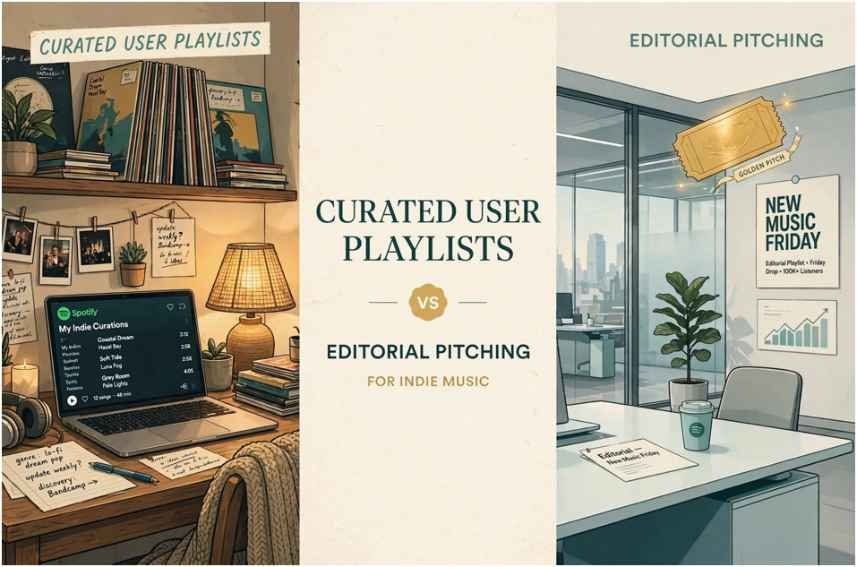
    Choosing between curated user playlists vs editorial pitching for indie music often feels like deciding whether to buy a lottery ticket or grind out door-to-door sales.

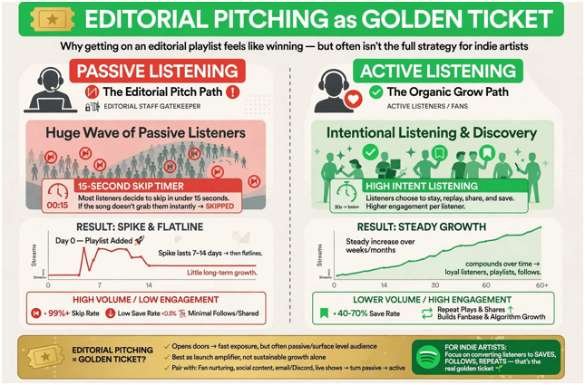
    I spent years assuming an editorial placement on Fresh Finds was the only milestone that mattered. Then I ran the numbers on my own catalog. A single editorial slot brought 45,000 passive streams over two weeks, followed by an immediate flatline. 

    Conversely, a coordinated push across 15 niche user-curated playlists triggered Spotify’s Discover Weekly engine for seven consecutive months.

    To build a career that survives past release day, you must treat user curation as your algorithmic engine and editorial pitching as your zero-cost amplifier.

    The Core Dilemma: Algorithmic Priming vs Flagship Reach

    Streaming platforms do not reward hype; they reward measurable listener engagement. Understanding the distinct roles of independent tastemakers and platform gatekeepers dictates where your time and release budget should go.

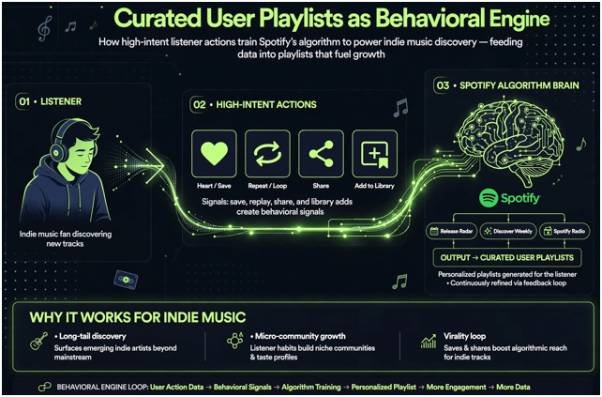
    Curated User Playlists: The Behavioral Engine

    Curated User Playlists: The Behavioral Engine

    User-generated playlists are maintained by music bloggers, indie labels, and dedicated music fans. These tastemakers curate for ultra-specific vibes: late-night studying, highway night drives, or underground Midwestern emo.

    When an indie artist lands on a focused user list, the listener rarely skips. They loop the track, share it, and add it to their personal libraries. According to submission data gathered by SubmitHub, high-intent third-party placements deliver up to four times higher profile-click rates than broad genre collections. 

    These genuine actions feed recommendation engines like Release Radar, Spotify Radio, and Discover Weekly. If you are refining your rollout schedule, pair this approach with our self releasing an album checklist for indie artists to ensure your timeline accounts for curator lead times.

    Editorial Pitching: The Golden Ticket

    Editorial Pitching: The Golden Ticket

    Editorial lists (New Music Friday, All New Indie) are assembled by in-house editorial staff at major streaming platforms. Landing one delivers immediate scale and immense industry prestige.

    However, editorial listeners are passive skippers. If an editor places your delicate indie-folk ballad between two high-energy pop tracks, casual listeners skip within 15 seconds. High skip rates punish your internal algorithmic score. 

    Treat native editorial forms on Spotify for Artists as a mandatory, free routine—never as a standalone marketing strategy. Even when editors pass, the metadata submitted during the pitch indexes your sound profile within the platform’s categorization matrix.

    Head-to-Head Comparison: Curated vs Editorial

    The table below breaks down the structural, financial, and operational differences between both avenues.

    Strategic Metric Curated User Playlists Editorial Pitching
    Primary Gatekeeper Independent tastemakers, bloggers, super-fans In-house platform editorial teams
    Submission Cost Free direct outreach; $2–$4 via review networks 100% Free via native artist dashboards
    Submission Window Anytime (pre-release or months post-release) Strict deadline (3–6 weeks before release)
    Listener Behavior Active listening, high saves, custom playlist adds High-volume passive listening, higher skip rates
    Impact on Algorithm High: builds targeted behavioral data Moderate: massive initial velocity, mixed signals
    Longevity Weeks to months; steady cumulative gains 7 to 14 days before rotation or replacement

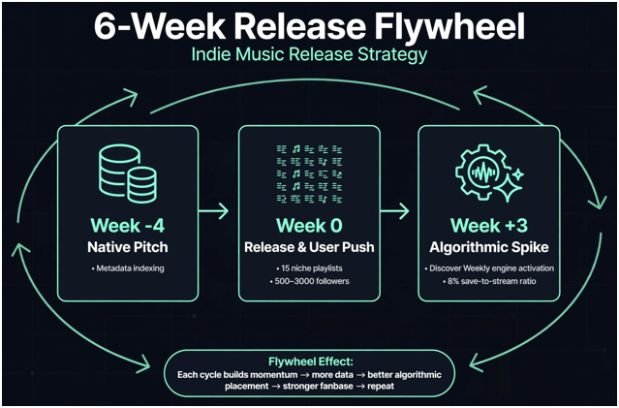
    The 6-Week Release Flywheel: How I Blend Both Strategies

    The 6-Week Release Flywheel: How I Blend Both Strategies

    Stop treating these distribution channels as mutually exclusive competitors. Instead, connect them in a single pipeline.

    [Week -4: Native Pitch] ➔ [Week 0: Release & User Push] ➔ [Week +3: Algorithmic Spike]

             │                                   │                                │

             ▼                                   ▼                                ▼

    (Metadata Indexing)                (High-Intent Saves)             (Editorial Re-Discovery)

    1. Four Weeks Before Release: Upload your finished master through your digital distributor. Submit your editorial pitch inside your streaming dashboard. Tag primary instruments, micro-genres, mood, and three sonic reference points.
    2. Release Week: Pivot entirely to verified user curators. Secure 10 to 20 placements across micro-playlists containing 500 to 3,000 followers. This deliberate audience targeting keeps skip rates low and save rates high.
    3. Three Weeks Post-Release: As your save-to-stream ratio crosses the 8% mark, recommendation algorithms activate. This secondary surge in daily active listeners flags your track on internal algorithmic dashboards, often prompting human editors to add your song to late-cycle playlists like Fresh Finds. While streaming brings passive ears, monetize that attention directly by funnelling active listeners into fan platforms for independent music sales.

    Vetting the Minefield: Spotting Artificial Playlists Before You Pitch

    Vetting the Minefield: Spotting Artificial Playlists Before You Pitch

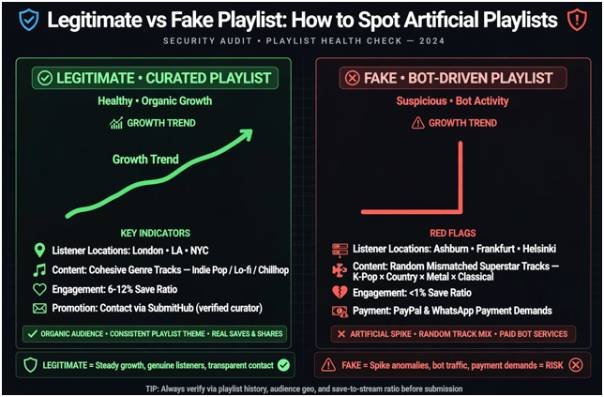
    The independent playlist ecosystem contains predatory pay-for-play schemes that use click-farms. Buying your way onto an artificial playlist ruins your catalog data and risks track removal, a crackdown widely reported across the industry by Billboard.

    Always audit a third-party playlist using the markers below before spending time or money pitching it.

    Verification Point Legitimate Curated Playlist Fake or Bot-Driven Playlist
    Follower Growth Curve Steady, stepped, natural fluctuation Sharp vertical leaps of thousands in 24 hours
    Top Audience Cities Major metropolitan areas (London, LA, NYC) Data-center clusters (Ashburn, Frankfurt, Helsinki)
    Curator Contact Info Submission platform links or plain submission emails Demands direct PayPal or WhatsApp payments
    Save-to-Stream Ratio Typically 6% to 12% saves per stream Less than 1% saves despite massive daily plays
    Track Sequencing Thematically cohesive, genre-consistent Random sequencing with mismatched superstar tracks

    Ditch the Vanity Metrics and Play the Long Game

    Chasing editorial placements while ignoring independent user curation is like trying to put a roof on a house that has no foundation. Editorial features look great in press releases, but user-curated playlists keep your royalties flowing long after release week ends.

    Treat every niche playlist with 400 dedicated listeners as a direct pipeline to your next 50 true superfans. Submit your free editorial pitch early, spend your promotional energy on genuine human tastemakers, and let behavioral data handle the rest.

    Frequently Asked Questions

    1. Does getting rejected by editorial curators hurt my algorithmic reach?

    No, editorial rejections do not penalize your track; the detailed genre tags you submit still train the recommendation engine.

    2. When is the absolute deadline to submit an editorial pitch?

    Submit your pitch at least 7 days before release for Release Radar inclusion, though 3 to 4 weeks is ideal for human review.

    3. Are paid playlist submission platforms considered payola?

    No, legitimate platforms charge for a curator’s guaranteed time and feedback, whereas payola involves paying for guaranteed placement.

    4. Can user playlists trigger Discover Weekly without any editorial support?

    Yes, high save rates and low skip rates on user playlists frequently trigger Discover Weekly without any editorial placement.

  • How Do Independent Artists Make Money? A Practical Revenue Breakdown

    How Do Independent Artists Make Money? A Practical Revenue Breakdown

    A million streams can sound like financial success until the money is divided among distributors, recording owners, publishers, songwriters, collaborators, and other rightsholders.

    That is why the better answer to how do independent artists make money has little to do with finding one magical revenue source. Successful independent musicians increasingly operate like small creative businesses, combining royalties, performances, merchandise, fan support, licensing, freelance work, and intellectual-property ownership.

    The strategy matters because artist income can be unpredictable. National Endowment for the Arts data based on the 2022 American Community Survey reported median earnings of $51,970 for full-time workers in its musician category, compared with $15,580 for those classified as part-time. Those figures cover occupational earnings rather than streaming income specifically, but they illustrate how widely musicians’ financial situations can vary.

    Independent Artists Usually Build an Income Portfolio

    The music business creates several ways to monetize the same creative career. One song might generate recording royalties from streaming, publishing income from the composition, money from a synchronization license, merchandise sales after a performance, and increased demand for paid live appearances.

    Berklee describes freelance musicians as earning from a portfolio that can include performance, recording, arranging, teaching, content, and project-based work. That portfolio approach is a useful model for independent artists because it reduces dependence on any one platform.

    Streaming Makes Money, but the Rights Behind the Stream Matter More

    Streaming is often the first revenue source artists think about, but there is no universal amount that an artist simply earns “per stream.”

    Payments depend on factors including the service, territory, royalty pool, distribution agreement, ownership structure, and contractual splits.

    More importantly, a recorded song can involve separate copyrights.

    The U.S. Copyright Office’s musician resources explain that the underlying musical composition and the sound recording are separate copyrighted works. Understanding that distinction can help independent musicians identify income they might otherwise overlook.

    Recording Revenue

    If an independent artist controls a master recording, revenue generated by that recording can flow to the artist or their business after distribution fees and contractual deductions.

    Ownership therefore matters almost as much as audience size.

    Songwriting and Publishing Revenue

    Songwriters may also earn from the composition itself through performance, mechanical, synchronization, and other licensing uses.

    An artist who writes and records a track can therefore participate in more than one revenue stream connected with the same song.

    The Copyright Alliance’s explanation of music licenses and royalties provides a useful breakdown of how compositions and sound recordings create different licensing rights under U.S. copyright law.

    Live Music Can Turn Attention Into Immediate Revenue

    For many artists, performances remain valuable because they can produce several transactions in one evening.

    Live Music Can Turn Attention Into Immediate Revenue

    A musician can receive a guaranteed performance fee, a percentage of ticket revenue, tips, merchandise sales, and new direct fan contacts from the same event.

    The opportunity extends beyond traditional tours. Independent musicians may perform at clubs, festivals, college events, weddings, house concerts, corporate functions, community events, and private celebrations.

    That makes touring only one version of live income. Artists unable or unwilling to spend months traveling can explore other approaches, including the ideas in this breakdown of how independent musicians make money without touring.

    The important number is not simply the performance fee. Artists should calculate:

    Net show income = total show revenue − travel − musicians − accommodation − production − commissions − merchandise costs

    A $1,500 booking can be less profitable than a $700 local performance if the larger event requires expensive travel and additional personnel.

    Merchandise Turns Fan Loyalty Into Higher-Value Purchases

    Streaming monetizes listening. Merchandise monetizes identity and connection.

    Merchandise Turns Fan Loyalty Into Higher-Value Purchases

    T-shirts, posters, signed physical releases, vinyl, limited-edition artwork, hats, and other items allow highly engaged listeners to spend substantially more than they would through repeated streaming alone.

    Artists should still treat merchandise as inventory rather than guaranteed profit.

    Before ordering 200 shirts, calculate the landed cost of every item, including manufacturing, artwork, packaging, transaction fees, shipping materials, and unsold stock.

    For example, an item sold for $30 with $12 in total variable costs produces a $18 contribution margin before overhead. Selling 50 produces $900 toward recovering other business expenses.

    Direct Fan Support Makes a Smaller Audience More Valuable

    Artists do not always need enormous audiences if a smaller group cares enough to support their work directly.

    Membership programs can offer demos, private livestreams, early releases, behind-the-scenes material, exclusive recordings, community access, or advance ticket opportunities.

    Crowdfunding serves a slightly different purpose. Instead of recurring support, fans help finance a defined project such as recording, mastering, vinyl manufacturing, or a music video.

    Artists considering that model can explore these crowdfunding strategies for independent album production before setting a funding target.

    The strongest offers give supporters something meaningful without creating so many rewards that fulfillment consumes the money raised.

    Sync Licensing Can Monetize Existing Music Again

    Synchronization licensing allows music to be used alongside visual media such as television programs, films, advertisements, online productions, or games.

    This is particularly attractive because an already-released track can become a new licensing asset without requiring the artist to create another product.

    Berklee’s music licensing resources emphasize understanding master rights, publishing rights, licensing opportunities, and rights administration as part of music monetization.

    Sync opportunities are not guaranteed, however. Clear ownership, accurate metadata, professional recordings, suitable material, and straightforward permission processes can make music easier to license.

    Skills Around Music Can Become Revenue Too

    A recording career creates marketable skills beyond releasing songs.

    Artists may earn money through session performances, beat production, songwriting, vocal recording, arranging, mixing, mastering, private lessons, workshops, or commissioned music.

    These services can be especially useful early in a career because they create cash flow while an artist’s catalog and audience are still developing.

    Some artists also pursue outside funding. Our overview of music grant opportunities for independent artists explains another route for funding creative work without treating grants as guaranteed recurring income.

    Do Not Confuse Revenue With Take-Home Income

    An artist earning $50,000 in gross receipts does not necessarily have $50,000 available to spend.

    Recording, advertising, travel, equipment, musicians, distribution, transaction fees, manufacturing, insurance, and taxes can substantially reduce take-home income.

    For U.S. artists operating as independent contractors or businesses, the IRS says gig and self-employment income must be reported, and qualifying self-employed workers may need to make estimated tax payments. The IRS also advises maintaining records of income and expenses.

    Its self-employed tax guidance is therefore worth reviewing once music starts generating meaningful revenue.

    Frequently Asked Questions

    1. How do independent artists make money without a record label?

    They can combine streaming and publishing royalties, performances, merchandise, direct fan memberships, licensing, teaching, session work, crowdfunding, commissions, and other creative services.

    2. Can independent artists survive on streaming alone?

    Some can, but relying exclusively on streaming creates concentration risk. Multiple income sources can provide greater flexibility when releases, algorithms, audience behavior, or platform economics change.

    3. Do independent musicians need a business?

    Not every musician needs a formal company immediately, but anyone regularly earning money should maintain accurate financial records, understand contracts and rights ownership, and follow applicable tax requirements.

    4. Is sync licensing realistic for small independent artists?

    Yes. Audience size is not the only consideration. Music supervisors and licensing partners may also care about suitability, recording quality, ownership clarity, metadata, pricing, and how quickly permission can be obtained.

    Building a Career That Does Not Depend on One Check

    The strongest independent music businesses rarely depend on a single viral song, platform, tour, or royalty payment.

    Instead, artists gradually build assets: songs they control, relationships with listeners, performance demand, merchandise customers, professional skills, licensing opportunities, and a reliable system for collecting the money those assets generate.

    That changes the original question. Instead of asking where the next payment will come from, ask which parts of your music career can produce value repeatedly. Build two dependable revenue streams first, measure their real profit, then add the next one. Independence becomes far more sustainable when creativity and business discipline work together.

  • How to Support Independent Musicians in Ways That Actually Matter

    How to Support Independent Musicians in Ways That Actually Matter

    One $25 T-shirt sold after a concert can sometimes matter more to an independent musician than hundreds or even thousands of passive streams. That contrast explains why understanding how to support independent musicians requires looking beyond simply pressing play.

    Independent artists often operate as performers, marketers, booking agents, content creators, merchandise sellers, and small-business owners at the same time. Without a major label absorbing expenses, money for recording, touring, artwork, promotion, equipment, and distribution frequently comes from the artist.

    The encouraging part is that fans have more influence than they may realize. Money helps, but attention, recommendations, attendance, and consistent engagement can also move an artist’s career forward.

    Why Independent Musicians Need More Than Streams

    Streaming is valuable because it helps musicians reach listeners anywhere. It can introduce an unknown artist in Nashville, Austin, Los Angeles, Chicago, or a small college town to audiences far beyond the local scene.

    But streaming should be treated as one part of supporting an artist rather than the entire strategy.

    Independent musicians usually build careers from several income sources: recordings, performances, merchandise, licensing, teaching, session work, memberships, crowdfunding, and direct fan purchases.

    That economic diversity matters. A National Endowment for the Arts analysis found that the economic value generated by independent artists, writers, and performers in 2023 was approximately back to its 2019 level, but it had fallen 11.9% from 2022. The figures show how quickly conditions can shift for people earning their living through creative work.

    Readers interested in the broader economics of creative work can explore the National Endowment for the Arts research on the U.S. arts economy.

    Spend Money Where More of It Reaches the Artist

    If you have money available to support a musician, start as close to the artist as possible.

    Buying an album, vinyl record, poster, shirt, cassette, signed item, or digital download directly from an artist gives them an immediate transaction rather than waiting for small amounts of revenue to accumulate through repeated listening.

    Berklee College of Music specifically highlights direct-to-fan platforms such as Bandcamp as a way for artists to sell music and merchandise while maintaining greater control over pricing and release strategy.

    The broader principle is simple: The fewer intermediaries between your wallet and the musician, the more meaningful a purchase may become. You can read Berklee’s discussion of direct-to-fan music marketing for independent artists.

    Merchandise Can Fund More Than You Think

    Merchandise is not merely advertising.

    A shirt sold tonight might help pay for tomorrow’s gas. A vinyl preorder may contribute toward mastering or manufacturing costs. Posters and limited editions can generate revenue while strengthening the connection between a musician and the people who follow their work.

    There is one important exception: margins vary. Manufacturing, fulfillment, venue merchandise fees, shipping, platform charges, and taxes can significantly reduce what an artist keeps.

    That is why purchasing through an artist’s official store or at a show is often worth considering first.

    Go to Shows—and Bring Someone

    Buying a ticket accomplishes several things simultaneously.

    Go to Shows—and Bring Someone

    The performer earns potential ticket or guarantee income. The venue sees demand. Promoters see that the artist can attract an audience. Merchandise has another opportunity to sell. Most importantly, actual attendance provides evidence that people will leave home to see that musician perform.

    Live participation remains an important part of the American arts ecosystem. The National Endowment for the Arts continually tracks how Americans attend and interact with performing arts through its national participation research.

    For fans wondering how to support independent musicians without dramatically changing their listening habits, attending one local show and bringing a friend is one of the most practical options.

    Do not underestimate the friend. One new listener who becomes a repeat concertgoer can be more valuable over several years than dozens of casual social-media impressions.

    Use Streaming More Intentionally

    You do not need to stop streaming music to become a better supporter. Instead, make your listening behavior more useful.

    Follow the artist’s profile. Save songs you genuinely enjoy. Add tracks to relevant personal playlists. Listen to albums instead of only isolated viral tracks. Share releases with people who are genuinely likely to enjoy them.

    Avoid artificial behavior such as repeatedly looping tracks purely to manipulate stream counts. Genuine listening and discovery are more sustainable.

    Streaming can introduce listeners to an artist; the next step is moving some of those listeners closer to the artist’s own ecosystem. That might mean an email newsletter, official website, merchandise store, concert calendar, or membership page.

    Join the Artist’s Mailing List

    Social-media visibility can disappear overnight when algorithms change. Email is different.

    A mailing list gives musicians a direct communication channel with listeners who have deliberately asked for updates. Artists can announce tours, limited releases, crowdfunding campaigns, preorders, and new songs without depending entirely on an algorithm deciding who sees the announcement.

    Berklee’s research and music-business education have long emphasized the value of musicians knowing their audience and creating direct relationships with fans. Its discussion of musicians as entrepreneurs frames audience development as part of building a sustainable career. See Berklee’s resource on musicians as entrepreneurs and direct fan relationships.

    Share Music Like a Human, Not a Promotion Bot

    Share Music Like a Human, Not a Promotion Bot

    “Check out this artist” is easy to ignore. A personal recommendation works differently. Tell someone why you like the song.

    Try:

    “This guitarist reminds me of the early records you love.”

    Or:

    “They’re playing downtown Friday, and I think you’d really like them.”

    Context turns promotion into discovery.

    Online, meaningful comments, reposts, playlist additions, reviews, video shares, and recommendations can introduce artists to audiences they could never afford to reach through advertising.

    The best promotion is targeted. Sending an experimental jazz record to 10 people who love experimental jazz can be more useful than indiscriminately sharing it with 1,000 people.

    Understand That Musicians Are Running Businesses

    Independent artists are creative people, but many are also self-employed business operators. They may have to handle taxes, contracts, insurance, licensing, accounting, marketing, travel, inventory, and intellectual property.

    The U.S. Small Business Administration explains that sole proprietors and other small-business owners must think about issues such as business structure, registration, taxes, licenses, banking, and insurance.

    That context helps explain why a $20 purchase does not automatically become $20 of personal income.

    For more background, see the U.S. Small Business Administration’s business guidance.

    Respect the Music as Intellectual Property

    Another overlooked form of support is simply respecting ownership.

    Downloading unauthorized copies, reposting full tracks without permission, using music commercially without appropriate licensing, or assuming online music is free to reuse can undermine creators.

    The U.S. Copyright Office explains that a song can involve two distinct copyrighted works: the musical composition and the sound recording. Copyright owners receive specific rights over reproduction, distribution, derivative works, and certain public performances.

    Its copyright guidance specifically for musicians is useful for understanding how music ownership works.

    Supporting an artist means respecting those rights as well as enjoying the finished recording.

    Do Not Forget the Musicians Behind the Artist

    Do Not Forget the Musicians Behind the Artist

    Independent recordings frequently involve drummers, producers, engineers, backing vocalists, instrumentalists, and session musicians. Supporting fair treatment across that ecosystem matters too.

    The American Federation of Musicians represents professional musicians and advocates for fair wages, working conditions, contracts, and protections for music workers.

    Its overview of professional musician protections and fair-pay resources illustrates how many economic issues exist behind the music fans eventually hear.

    Frequently Asked Questions

    1. What is the easiest way to support an independent musician?

    Buy directly from the artist, attend shows, follow their accounts, save their music, join their mailing list, and recommend them to people who genuinely enjoy similar music.

    2. Does streaming actually help independent artists?

    Yes, streaming can generate revenue and discovery, but it usually works best alongside direct purchases, live attendance, merchandise sales, memberships, and other fan support.

    3. Can I support independent musicians without spending money?

    Absolutely. Sharing releases, saving songs, commenting meaningfully, following artist profiles, joining mailing lists, making playlists, and bringing attention to upcoming shows can all help.

    4. Is buying merchandise better than streaming?

    They serve different purposes. Streaming improves reach and discovery, while a direct merchandise purchase may provide a larger immediate transaction. Combining both is often more useful than choosing only one.

    The Support That Builds Careers

    Learning how to support independent musicians ultimately means recognizing that attention has value only when some of it becomes action.

    Listen to the track, but also save it. Love the album, but consider buying it directly. Enjoy the show, but bring a friend. Follow the artist, but join the mailing list so the relationship does not disappear with the next algorithm update.

    No individual fan has to finance someone’s career. What makes independent music sustainable is thousands of small decisions made consistently by real listeners.

    A $25 shirt may look like merchandise. To the person loading instruments into a van after midnight, it may look like enough gas to reach the next show.

  • What Is an Independent Artist? How Indie Musicians Actually Build Careers

    What Is an Independent Artist? How Indie Musicians Actually Build Careers

    An independent musician can release a song worldwide without ever walking into a major record label’s office. That single shift has changed what it means to build a music career.

    So, what is an independent artist? In practical terms, it is a musician or creator who operates outside the traditional major-label system and maintains significant control over decisions such as recording, releases, marketing, financing, rights, and career direction.

    Independence does not necessarily mean working alone. Successful indie artists may have managers, distributors, producers, attorneys, publicists, booking agents, and other professionals around them. The difference is who ultimately controls the business.

    What Being an Independent Artist Really Means

    The simplest definition focuses on control rather than fame.

    What Is an Independent Artist How Indie Musicians Actually Build Careers


    An independent artist generally records and releases music without being bound to a traditional major-label recording agreement. The artist may finance projects personally, use an independent distributor, form a small label, hire contractors, or enter limited service agreements.

    The American Association of Independent Music represents independent labels and recording artists in the United States and describes independence partly through ownership and control rather than simply distribution. 

    That distinction matters because an artist can distribute music through a large company without necessarily surrendering control of the underlying recordings.

    Independent Does Not Mean Unsigned in Every Situation

    “Unsigned artist” and “independent artist” are frequently treated as synonyms, but they are not always identical.

    An unsigned musician has no recording contract with a label. An independent musician might have agreements with an independent label, distributor, publishing administrator, manager, or licensing company while still controlling major parts of the career.

    Independence is therefore better viewed as a spectrum.

    The important questions are: Who owns the recordings? Who approves releases? Who finances the project? Who controls marketing decisions? How long do contractual rights last?

    The Two Copyrights Every Independent Musician Should Understand

    Ownership is one of the strongest reasons musicians pursue independence, but there is an important misconception here: being independent does not automatically mean you own everything. A recorded song commonly involves two separate copyrights.

    According to the U.S. Copyright Office, one protects the musical work—the composition and lyrics—while another protects the particular sound recording. Copyright generally begins once an original work is fixed in a tangible form, such as an audio recording or written notation. 

    An artist who writes and records a song independently may potentially control both rights, but collaborators, producers, publishers, work-for-hire arrangements, samples, and contracts can change the ownership picture.

    The Copyright Alliance also explains that musical works and sound recordings generate different licensing and royalty opportunities. 

    For an indie musician, understanding those distinctions can be just as important as writing the song itself.

    Independent Artist vs. Major-Label Artist

    The real difference is not simply whether one artist has a company logo behind the album.

    Area Independent Artist Traditional Major-Label Artist
    Creative decisions Usually retains greater control May require label approval
    Recording budget Often self-funded or independently financed Label may provide recording budget or advance
    Master ownership Can retain ownership depending on agreements Depends heavily on recording contract
    Marketing Artist or hired team manages promotion Label infrastructure may provide greater support
    Release timing Usually more flexible Often coordinated with label strategy
    Financial risk Artist carries more upfront risk Label may finance significant expenses
    Revenue share Potentially greater share, but artist pays costs Contract determines artist royalties and recoupment

    Neither structure guarantees success.

    Independence gives artists more authority, but major labels can provide capital, staff, industry relationships, international marketing, radio promotion, and other resources that are difficult for one artist to reproduce.

    Why Artists Choose to Stay Independent

    Why Artists Choose to Stay Independent

    Creative Decisions Stay Closer to the Artist

    An independent artist can often decide what to record, which producer to hire, what the artwork looks like, when music comes out, and whether a commercially unusual song deserves a release.

    There is no guarantee audiences will respond, but fewer corporate approval layers can make experimentation easier.

    Artists Can Build Their Own Audience

    Social platforms, streaming services, email, live performances, online communities, merchandise stores, and direct-to-fan platforms have reduced the dependence musicians once had on record-company distribution.

    Berklee notes that musicians can now create music with relatively accessible equipment, promote it online, and release material independently, although earning enough to make recording a full-time career remains difficult. 

    Direct fan relationships are particularly valuable because they give artists something streaming numbers alone cannot provide: an identifiable community that may buy tickets, merchandise, memberships, or future releases.

    Independence Can Improve Economics—but Not Automatically

    You will often hear that independent artists “keep all their money.” That is misleading. An artist who owns recordings may avoid giving a traditional label a large contractual share, but distribution fees, production, mastering, artwork, advertising, management, touring, accounting, legal work, and taxes still cost money.

    Keeping a larger percentage means little if the artist has also assumed every expense.

    The Difficult Part: Becoming the Artist and the Business

    Independent musicians frequently discover that releasing music is only one part of the job.

    Berklee describes freelance musicians as professionals who may manage contracts, schedules, invoicing, marketing, equipment, taxes, and professional relationships alongside the actual creative work. 

    That means an emerging artist may spend Monday recording vocals, Tuesday editing video, Wednesday pitching shows, Thursday reviewing analytics, and Friday handling invoices. The freedom is real. So is the workload.

    The US Business Side Artists Cannot Ignore

    The US Business Side Artists Cannot Ignore

    For American musicians, independence can also mean becoming self-employed.

    The IRS says people who operate a trade or business for themselves can fall under self-employment rules. Self-employed individuals generally have federal income-tax obligations and may need to make estimated tax payments.  That makes recordkeeping important.

    Track recording expenses, contractor payments, equipment, eligible travel expenses, merchandise income, performance fees, royalties, distribution income, and other business transactions. Musicians with complicated royalty streams or business structures may benefit from an accountant or attorney experienced in entertainment.

    Common Misconceptions About Indie Artists

    An independent artist is not automatically an amateur.

    Independent musicians can have substantial audiences, professional teams and sophisticated businesses.

    Independence also does not guarantee complete ownership. A poorly understood producer, publishing, financing, distribution, or licensing agreement can transfer valuable rights.

    Finally, independence is not necessarily the “better” career model. Some musicians want the resources and organizational support of a label. Others value ownership and flexibility enough to accept greater financial risk.

    Frequently Asked Questions

    1. What is an independent artist in music?

    An independent artist releases and manages music outside the traditional major-label structure, usually retaining greater control over creative decisions, business strategy, financing, rights, and release plans.

    2. Do independent artists own their masters?

    Often, but not automatically. Master ownership depends on contracts with producers, labels, investors, distributors, and other partners. Artists should verify ownership terms before signing agreements.

    3. Can an independent artist have a manager?

    Yes. Independence does not mean doing everything alone. Independent artists can hire managers, attorneys, producers, publicists, booking agents, accountants, and distributors while retaining control of their careers.

    4. Do independent artists pay taxes?

    US artists earning money independently may have self-employment and income-tax obligations. Requirements depend on circumstances, income, expenses, and business structure, so professional tax advice may be appropriate.

    Independence Is Really About Control

    Understanding what is an independent artist becomes easier once you stop picturing a musician working completely alone. Independence is fundamentally about how control, ownership, risk, and decision-making are structured.

    Modern tools have made recording and releasing music far more accessible, but they have not eliminated the difficult work behind a sustainable career. The independent musician may gain creative freedom, closer fan relationships, and valuable ownership while simultaneously becoming a marketer, business owner, financial planner, and team leader.

    The strongest indie career, then, is not necessarily the one with the fewest partners. It is the one where the artist understands exactly what each partnership costs—and what control remains afterward.

  • Do I Need a MIDI Keyboard for Music Production? Start Here

    Do I Need a MIDI Keyboard for Music Production? Start Here

    Buying music gear can make beginners feel like they need a full studio before they can create anything worthwhile. I see MIDI keyboards on countless home-studio desks, but that does not mean they are essential. If you are asking Do I need a MIDI keyboard for music production, the real answer depends on how you prefer to write, arrange, and perform your ideas.

    You can build complete tracks with a laptop, DAW, mouse, computer keyboard, piano roll, samples, and step sequencer. A MIDI controller simply gives you a more hands-on way to play melodies, test chords, control virtual instruments, and capture expressive performances. For me, the right time to buy one is when clicking notes starts slowing down the creative process.

    Can You Produce Music Without a MIDI Keyboard?

    Yes. Every major digital audio workstation gives you several ways to write music without physical keys.

    The most common method is the piano roll. I can draw MIDI notes directly onto a grid with a mouse, adjust their length, move them to different pitches, change velocity, and copy entire chord progressions. This approach gives me extremely precise control and can actually be easier than live playing when I am creating complex patterns.

    Most DAWs also offer musical typing, which lets a regular QWERTY computer keyboard trigger notes. It is not as expressive as a velocity-sensitive MIDI controller, but it is perfectly usable for testing melodies and entering simple musical ideas.

    Step sequencers provide another option. Producers making hip-hop, electronic music, trap, or other beat-driven styles can program drums, basslines, and melodic patterns directly on a grid. Sample-heavy production can go even further. I can arrange loops, manipulate recorded audio, trigger drum kits, and build full tracks without playing a traditional keyboard at all.

    This is why a MIDI controller should never be considered a requirement for getting started. The same laptop-first approach is useful for beginners wondering how to start music production with just a laptop, since a DAW, piano roll, virtual instruments, samples, and a computer keyboard can provide enough tools to begin creating complete tracks.

    What Does a MIDI Keyboard Actually Do?

    A MIDI keyboard usually does not produce sound on its own. Instead, it sends MIDI information to a computer, DAW, virtual instrument, or compatible piece of hardware.

    When I press a key, the controller can tell my software which note I played, when I played it, how long I held it, and how hard I pressed it. The virtual instrument then turns that information into sound.

    That means the same MIDI keyboard can control a piano plugin one minute and a synthesizer, bass, string library, or drum instrument the next.

    In practical terms, it works more like an input device for music than a standalone instrument.

    Why Do So Many Producers Eventually Use a MIDI Controller?

    Why Do So Many Producers Eventually Use a MIDI Controller

    Even though it is optional, a MIDI keyboard can make music production much faster.

    Does a MIDI Keyboard Make Writing Melodies Faster?

    For me, one of the biggest advantages is speed.

    Finding a melody by clicking notes one at a time can interrupt the creative process. When I have physical keys in front of me, I can immediately experiment with melodies, basslines, and chord progressions.

    I do not need advanced piano skills. Even knowing where a few notes and basic chords are located can make idea generation more fluid.

    This becomes especially valuable when working with virtual instruments because I can audition different sounds while actually playing them.

    Can a MIDI Keyboard Make Music Sound More Human?

    Yes, particularly when the controller has velocity-sensitive keys.

    Velocity records how hard I press a key. A softer press can create a quieter or gentler sound, while a harder press can trigger a stronger response depending on the virtual instrument.

    That variation adds human expression to a performance.

    If every programmed note has identical velocity and perfectly aligned timing, the result can sound mechanical. I can manually adjust those details in the piano roll, but a live MIDI performance captures many of those variations naturally.

    This is especially useful for virtual piano, strings, electric piano, synthesizers, and orchestral instruments.

    What Do Pads, Knobs, and Faders on MIDI Keyboards Do?

    Modern MIDI controllers often do much more than send keyboard notes.

    Many include drum pads that let me tap out rhythms instead of clicking drum hits into a sequencer. Pads can also trigger samples, loops, or clips depending on the DAW.

    Assignable knobs allow me to control synth parameters, effects, filters, automation, and other software settings in real time. Faders can control volume, while transport buttons can handle play, stop, and record functions.

    Pitch bend and modulation controls provide another layer of expression.

    This type of DAW integration can reduce the amount of time I spend reaching for a mouse and make the production process feel more hands-on.

    Do Beginners Need a MIDI Keyboard?

    Do Beginners Need a MIDI Keyboard

    Beginners do not need one immediately.

    I would first learn how to navigate a DAW, create MIDI notes, edit audio, arrange tracks, use virtual instruments, program drums, and build basic mixes.

    I would first learn how to navigate a DAW, create MIDI notes, edit audio, arrange tracks, use virtual instruments, program drums, and build basic mixes. This foundation is also important when learning how to learn music production from scratch at home, because understanding the DAW and core production workflow should come before deciding which hardware is necessary.

    Once I understand how I naturally like to create music, hardware decisions become much easier.

    If I constantly find myself wishing I could play melodies instead of drawing them, test chords more quickly, or perform software instruments naturally, then a controller solves a real workflow problem.

    If I mostly work with samples, loops, vocals, guitar recordings, or step sequencing, I may not need one at all.

    Do You Need to Know Piano to Use a MIDI Keyboard?

    No. A MIDI keyboard does not require formal piano training.

    I can start by learning basic note positions and simple chord shapes. That alone can make writing music easier.

    Over time, using keys can also help me understand scales, intervals, chord construction, and basic music theory because the notes are laid out visually.

    Complex two-handed performances are optional. Producers can record one part at a time, fix mistakes afterward, or edit notes inside the piano roll.

    Is a 25-Key or 49-Key MIDI Keyboard Better?

    A 25-key controller works well for small US home studios, dorm rooms, apartments, and portable laptop setups. It provides enough range for basslines, melodies, simple chords, synth parts, and beat-making.

    A 49-key controller gives me more room to play chords and melodies without constantly changing octaves. It is usually more comfortable for someone who uses virtual instruments often or wants to play with both hands.

    Larger 61-key and 88-key models make more sense for keyboard-focused musicians, composers, or producers using detailed piano and orchestral arrangements.

    The right size depends more on workflow and available space than on experience level.

    Should You Buy a MIDI Keyboard Right Away?

    Should You Buy a MIDI Keyboard Right Away

    Before spending money, I would try producing several tracks without one.

    Use the piano roll. Try musical typing. Build beats with a step sequencer. Arrange samples. See which part of the process feels slow.

    See which part of the process feels slow. The same workflow mindset applies when evaluating playback quality, since understanding why does my mix sound different in the car can help producers identify whether their monitoring setup, mix balance, or listening environment is affecting how a track translates outside the studio.

    If manually entering notes starts holding back your ideas, a MIDI keyboard may be a worthwhile upgrade.

    The purpose of music-production gear should be to remove friction, not simply to make a studio look more professional.

    Frequently Asked Questions 

    1. Can I Make Professional Music Without a MIDI Keyboard?

    Yes. Producers can create complete professional tracks using a DAW, mouse, samples, computer keyboard, piano roll, and step sequencer. A MIDI keyboard improves workflow but does not determine production quality.

    2. Do I Need a MIDI Keyboard for Music Production as a Beginner?

    If you are asking Do I need a MIDI keyboard for music production, I would start without one unless playing melodies and chords is central to your workflow. Learn your software first, then buy hardware when you understand what would genuinely improve your process.

    3. Can I Use My Laptop Keyboard Instead of a MIDI Keyboard?

    Yes. Many DAWs let you use a laptop keyboard as a basic musical keyboard. It works for entering notes and testing ideas, although it does not provide velocity sensitivity, pads, modulation controls, or the range of a dedicated controller.

    4. Is a MIDI Keyboard Useful for Beat Making?

    Yes, especially if it includes drum pads. You can use it to play drum patterns, basslines, melodies, chords, and samples. However, beat makers can also work entirely with a mouse and step sequencer.

    5. Does a MIDI Keyboard Make Sound by Itself?

    Most MIDI controllers do not have built-in sounds. They send MIDI data to software instruments or external hardware that creates the audio.

    Final Thoughts

    When someone asks me whether I need a MIDI keyboard for music production, I think the most useful answer is to start making music with what you already own.

    A computer, DAW, mouse, piano roll, musical typing, step sequencer, and samples can take you surprisingly far. There is no need to delay learning music production because your home studio does not include a keyboard controller.

    However, once clicking notes starts slowing you down, a MIDI keyboard can become one of the most useful tools in your setup. It can speed up songwriting, make virtual instruments more expressive, improve DAW control, and help musical ideas feel more immediate.

    Buy one because your workflow needs it, not because you think every producer is supposed to have one.

  • How Do Bands Split Royalties? A Practical U.S. Guide

    How Do Bands Split Royalties? A Practical U.S. Guide

    A four-person band can record one song together and still end up with four very different royalty checks. That happens because there is no single pot called “music royalties.” A released track can contain two separate copyrights, several income streams, and agreements that assign each stream differently.

    So, how do bands split royalties fairly? The practical answer is to separate songwriting ownership from master-recording ownership, decide percentages before money arrives, and document those decisions track by track. For U.S. bands, understanding that distinction is more important than simply agreeing to “split everything four ways.”

    The First Rule: One Song Can Contain Two Copyrights

    The U.S. Copyright Office distinguishes between the musical composition and the sound recording. They may sound inseparable to a listener, but legally they are different works.

    The composition covers the underlying music and lyrics. Songwriters, composers, and lyricists are normally the people creating that work.

    The sound recording, often called the master, is the particular recorded performance. Performers and producers may contribute authorship to the recording, while contractual arrangements can determine who ultimately owns or controls it.

    This distinction explains why a guitarist might receive money from the master but no songwriting income, while a singer who wrote the lyrics could receive income from both.

    Revenue area What it relates to Typical beneficiaries
    Composition/publishing Melody, harmony, lyrics and underlying song Songwriters, composers, publishers
    Master recording Specific recorded performance Master owner, label, artists under contract
    Performance royalties Public or licensed performances of composition Writers and publishers
    Mechanical royalties Reproduction/distribution of composition Writers and publishers/rightsholders
    Certain digital-performance royalties Noninteractive digital use of recordings Recording rightsholders and eligible performers

    How Do Bands Split Royalties From Songwriting?

    The first question should not be, “Who played on the track?”

    It should be, “Who actually created the song?”

    Under U.S. copyright law, copyright initially belongs to the author or authors. Authors of a qualifying joint work become co-owners, although ownership can later be transferred or divided through agreements. That means membership in a band does not automatically create songwriting ownership. You should know how to support independent musicians. 

    Imagine Maya writes the lyrics and vocal melody. Devon creates the chord progression and major instrumental structure. Two other band members learn their parts after the song is substantially written.

    The group might decide the composition is:

    Maya: 60%
    Devon: 40%
    Other members: 0%

    Another band may deliberately adopt an equal-writing policy and assign 25% to each member because everyone contributes during rehearsal.

    Both models can work if everyone understands and agrees to them.

    Arrangement Is Not Automatically Songwriting

    Arrangement Is Not Automatically Songwriting

    This is where arguments often begin. A drummer may create a memorable groove. A guitarist may invent a distinctive tone. A bassist may completely change the energy of a chorus.

    Those contributions can be creatively essential without necessarily creating ownership in the underlying composition. Whether a contribution qualifies as copyrightable authorship can be fact-specific. Bands therefore benefit from defining their own songwriting rules before the disagreement occurs.

    Master Royalties Can Follow a Completely Different Split

    Suppose the same four-person group decides everyone contributed equally to recording the track.

    They could split the master:

    Singer: 25%
    Guitarist: 25%
    Bassist: 25%
    Drummer: 25%

    Notice what happened. The composition might remain 60/40 between two writers, while the master is divided equally among four performers.

    That is normal.

    The Copyright Office specifically recognizes compositions and recordings as separate works and notes that performers, producers, or others may contribute to sound-recording authorship.

    Other arrangements are possible. A band might give a producer master points, let one member own the recording because that person financed it, or assign the master to the band’s business entity.

    The important principle is that “equal band members” does not automatically mean “equal owners of every copyright.”

    Streaming Makes the Money Trail More Complicated

    A Spotify stream does not simply generate one royalty that Spotify sends to the drummer, guitarist, singer, and bassist. Different rights are involved.

    Streaming Makes the Money Trail More Complicated

    Income connected with the recording generally moves through the master side, often involving a distributor, label, or recording owner. Meanwhile, composition-related mechanical royalties from eligible U.S. interactive digital uses can pass through the Mechanical Licensing Collective under the system created by the Music Modernization Act.

    Songwriters also need accurate ownership information attached to their works.

    The Copyright Office notes that creators or their representatives need appropriate registrations and ownership information so royalties can be matched correctly. The MLC maintains musical-work data that includes ownership shares.

    Meanwhile, certain noninteractive digital performances of sound recordings operate differently. The American Federation of Musicians notes that statutory digital-performance royalties can reach copyright holders, featured artists, and qualifying nonfeatured performers.

    This is why one universal percentage cannot describe every payment a band receives.

    A Simple Royalty-Split Test Before Releasing a Song

    Before uploading a track, run through five questions.

    1. Who wrote the underlying song?

    Identify who created copyrightable elements such as lyrics, melody, harmony, and other songwriting material. Figure how do bands write songs together.

    Do not begin with band seniority or friendship. Begin with actual authorship, then decide whether your band agreement modifies how income will be shared.

    2. What are the composition percentages?

    Make the percentages total 100%. If four members agree to equal songwriting ownership, that means 25% each. If two writers created the song equally, that could mean 50% each.

    3. Who owns the master?

    Determine who paid for, produced, performed on, or contractually owns the recording. Do not assume the songwriting percentages should automatically become the master percentages.

    4. Are outside collaborators involved?

    Producers, guest writers, featured performers and session musicians can introduce additional rights or contractual payments. Settling those terms after release is considerably harder than doing it before distribution.

    5. Has everyone signed the same information?

    Create a split sheet for every song. At minimum, record the song title, legal names of writers, ownership percentages, contact information and signatures. Keep copies with the band’s business records.

    Why “We’ll Figure It Out Later” Is Expensive

    Small bands sometimes postpone royalty discussions because percentages feel awkward before a song earns anything.

    That approach becomes dangerous precisely when the song succeeds.

    Metadata may already have been submitted. Writers may register conflicting percentages. A distributor may be paying the wrong party. A licensing opportunity can arrive while ownership remains disputed.

    Written agreements are not signs of distrust. They create a shared record of what everyone previously decided.

    The Copyright Alliance’s explanation of U.S. music licensing also shows why accurate ownership matters: mechanical, performance, master, and synchronization uses can involve different parties and licensing pathways.

    What About Sync Deals?

    What About Sync Deals

    A television producer wanting to place your recording in a show may need permission covering both sides of the song. There can be a license for the composition and another for the master recording.

    If three people own the composition while a band company owns the master, the resulting payments may therefore be divided according to two entirely different ownership structures. This is another reason a single “band royalty percentage” is usually inadequate.

    Frequently Asked Questions

    1. Do bands normally split royalties equally?

    Some do, but there is no universal split. Bands can divide master ownership equally while allocating songwriting royalties only to contributing writers.

    2. Does every band member receive publishing royalties?

    No. Publishing income generally follows ownership in the composition. A member who did not contribute songwriting authorship does not automatically receive a share merely for performing.

    3. Can bands change royalty percentages later?

    Potentially, but changes can require agreements, ownership transfers and updated registrations. Settling percentages before release is much easier.

    4. Should bands use split sheets?

    Yes. A signed split sheet records songwriter percentages and helps prevent conflicting ownership claims when songs are registered, licensed or monetized.

    The Split Matters Before the Money Does

    The best time to answer how do bands split royalties is while the song is still being finished, not after it starts generating meaningful income. Separate the composition from the master. Decide who created and owns each one. Record the percentages, document outside collaborators, and make sure every registration reflects the same information.

    A song can survive a dozen revisions, multiple producers and years of touring. Its ownership structure may last even longer. Ten minutes spent discussing percentages before release can prevent years of confusion after it.